
Smart, Safe, and Online: Digital Citizenship for Online Private School Students
Students do not just use technology for schoolwork. A real share of their social lives happens online, and for a virtual school student the screen is also the classroom. In Pew Research Center's 2025 survey of U.S. teens, about one in five said they are on TikTok or YouTube almost constantly, and roughly three in ten use an AI chatbot every day.
Digital citizenship is the set of habits that lets a student use that screen safely, respectfully, and on purpose. Like any life skill, it is taught early, often, and by example.
At SVPS, students learn on a schedule built around them, with personalized instruction and teachers who know them well. Flexible pacing is a gift. It also means more hours on a screen without a bell to end them. For who to contact at school, see how communication drives success in online learning.
You do not need to be a technical expert to raise a good digital citizen. You need consistent conversations, guardrails that match your student’s age, and genuine curiosity about their online world. October is Cybersecurity Awareness Month, which makes this week a convenient excuse to have the passwords talk.
What Is Digital Citizenship for Online Private School Students?
Digital citizenship is the set of skills and habits that help a student navigate the online world safely, ethically, and productively. For a virtual school student, it also means using school platforms well, staying focused when a lesson lives in a browser, and knowing exactly who to tell when something feels wrong.
Most families find it easiest to think about in three parts:
Safety: protecting passwords, personal details, and location, and recognizing when someone online is not who they claim to be.
Respect: writing to classmates and teachers the way you would speak to them face to face, in chats, discussion boards, and comments alike.
Judgment: deciding what to trust, what to share, and when to log off.
Why Online Safety for Kids Looks Different When School Is Online
Online safety looks different in virtual school because the family, not a school building, sets the device rules. According to the National Conference of State Legislatures, 42 states plus Washington, D.C., and Puerto Rico have now enacted laws on student cellphone use in schools. Those rules work because a building enforces them: a pouch, a locker, a teacher at the door.
At home, the enforcement is you. That is more work. It is also the advantage, because the rules can fit your student instead of a hallway full of students.
SVPS still does its part. The school monitors secure learning platforms, constantly ensuring digital safety while out support teams help families navigate those platforms.
Knowing where the school's responsibility ends and yours begins is the first piece of digital citizenship for any virtual school family.
How Much Screen Time Is Right for an Online School Student?
There is no single correct number of hours. The American Academy of Pediatrics' 5 Cs of Media Use move the question away from hour counts and toward whether screens are crowding out what your family values, like sleep, movement, and time together. For a virtual school family, learning screen time is a given. The challenge is balance.
Separate Learning Screens From Leisure Screens
School hours on the laptop are one thing; gaming and videos after school are another. Separating screens builds the self-awareness behind good time management strategies for virtual students.
Build Screen-Free Windows Into the School Day
Meals, the hour before bed, and time outside are the low-conflict places to start. A school day with real breaks already has these windows built in; see a daily schedule with built-in breaks for a model. For teens, the AAP's 5 Cs guidance for older teens suggests charging the phone across the room overnight.
Review Device Dashboards Together
Most phones, tablets, and laptops include a screen-time dashboard. Review it together instead of imposing a limit from it: ask what surprised them, what felt worth it, and what they would change. Keep the rule for the whole family, adults included. Kids notice.
How Do I Teach My Child to Be Safe Online? Five Rules for Every Age
Online safety for kids starts with one reflex: pause before you share, click, or reply, and bring anything odd to a trusted adult. The five rules below hold at every age; only the conversation around them grows up.
Keep Personal Information Off the Internet
Full name, home address, school name, and location stay private from anyone your student knows only online. For a virtual school student, that also includes the portal login and anything visible on screen during a live session.
Think Before You Post
One family rule covers most situations: would you be okay with a teacher or a grandparent seeing this?
Use Strong Passwords and Age-Appropriate Filters
Use a unique password for every account, a password manager for teens, and parental controls matched to age. School accounts count too. A guessable portal password is an easy weak point to overlook in a virtual school household.
Know the Red Flags
Teach your student to notice and report:
Strangers asking personal questions
Requests to keep a conversation secret
Pressure to move to a different app or private chat
Offers of gifts, money, or game currency
Keep the Door Open
Kids report what they see when they know it will not cost them their device. Say it out loud, and mean it: coming forward is never punished, even if they were somewhere they were not supposed to be.
Online Safety for Kids by Grade Level
The rules stay the same as students grow. What changes is how much independence they get and what you talk about.
| Grade band | The device rule | The conversation |
|---|---|---|
| K-5 | Devices stay in shared spaces. Unfamiliar messages go to a trusted adult right away. Downloads need a yes first. | What is private, what is kind, who to tell. |
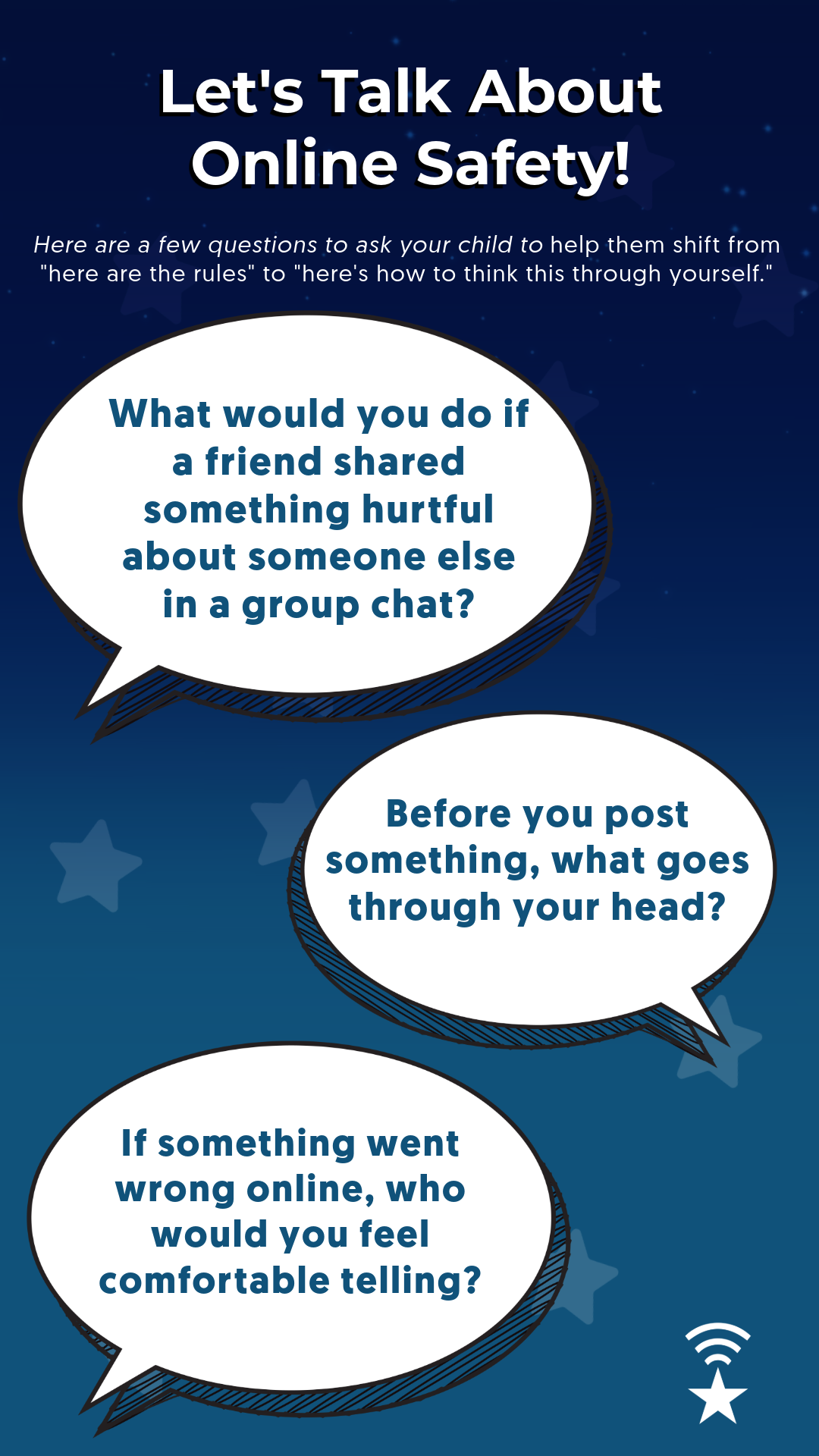
| 6-8 | Shared spaces for schoolwork, a device bedtime, parental controls on. First group chats and accounts happen here. | Real scenarios: what would you do if a friend posted something cruel about a classmate? |
| 9-12 | A weekly check-in, not a device inspection. Controls loosen as judgment shows. | Digital footprint, misinformation, and reporting, handled as a peer rather than a suspect. |
Digital Citizenship When Your Student Sets the Pace
Self-paced learning changes the screen-time math. A student who can work at 9 p.m. on a Tuesday needs rules that follow the work, not the clock on a school wall. Most states' new classroom phone laws are written for public school buildings, so for an online private school family, the device rules are yours to design.
Three adjustments make the rest of this guide fit a flexible schedule:
Name the school hours, even when they move. Write tomorrow's work block on a sticky note each evening. When the block ends, the laptop shifts from a learning screen to a leisure screen.
Set a device bedtime that does not flex. Pacing can bend; sleep should not. Charging the phone outside the bedroom is the simplest way to hold the line.
Add a pacing line to your family agreement. Which hours are school, which are not, and who decides when a late session is worth it.
When something goes wrong on a school platform, your student's academic advisor is the first call. Because instruction at SVPS is built around the individual student, that conversation can happen quickly and with someone who already knows your student.
How Should Digital Citizenship Conversations Change in Middle and High School?
In middle and high school, the conversation shifts from "here are the rules" to "here is how to think it through." Older students will spend time in group chats and online communities no adult supervises, so internalized judgment does more work than any restriction. This is also the age to add healthy skepticism: question sources, recognize misinformation, and ask who benefits when a post goes viral.
Talk Through Real Scenarios
Skip the hypotheticals and ask what they would do if a friend shared something hurtful about a classmate in a group chat, or if an AI chatbot gave them an answer that seemed off. Then mention the digital footprint once, without a lecture: what a student posts now can be seen later by teachers, coaches, admissions readers, and employers.
Cyberbullying: Reporting Is Not Snitching
Snitching gets someone in trouble. Reporting gets someone out of it, including yourself. Online clubs and class chats run better when students know the difference; see how personalized a virtual private school can be for where those connections happen.
What to Do When Something Goes Wrong Online
When something goes wrong online, stay calm, thank your student for telling you, and work through it in order. StopBullying.gov recommends the same core moves: don't respond, keep evidence, block, and report.
Preserve, then block. Screenshot the message with the date and username visible, block the account, and do not reply.
Tell the school if a classmate or school platform is involved. Start with your student's teacher or academic advisor. Here is how to reach your virtual school teachers.
Report to the platform. Every major app has a reporting tool. Use it even when the school is already involved.
Escalate when it crosses a line. Threats of violence, sexual content involving a minor, or an adult pressuring a child go to local law enforcement and to the National Center for Missing and Exploited Children's CyberTipline. Do not wait until you are certain.
A Simple Family Technology Agreement
The most durable tool in this post is one page on the fridge. As part of the Learning Coach's role at home, write it with your student, not for them. A good agreement covers:
Where devices live during school hours and overnight
Which apps are approved, and how new ones get added
Your family's screen-free windows
What gets reported, and the promise that reporting is never punished
Which hours count as school hours on a self-paced day
When it gets reviewed, such as at each grading period
Revisit it whenever a new device, account, or app arrives.
Frequently Asked Questions
At what age should I start teaching digital citizenship?
As soon as your student uses any connected device. A tablet for a young learner is the place to start with simple rules: ask before downloading, show an adult any unfamiliar message, and keep screens in shared rooms. The rules grow with them.
Should I monitor my teen's social media accounts?
Most families land on a middle path: stay connected as a follower, keep parental controls on for younger teens, and shift toward trust-based check-ins as your student shows good judgment. Secret surveillance tends to end the very conversations you most need to keep.
What do I do if my student sees something inappropriate online?
Stay calm, thank them, and handle it together rather than with an immediate restriction. Ask what they saw and how they got there, block or filter as needed, and tell them that coming to you was the right call.
How is digital citizenship different for virtual school students?
Virtual school students practice digital citizenship in the open every day: staying on task, writing respectfully to teachers and classmates, and managing their own screen time. The school manages the learning platforms; the family sets the device rules a classroom would set by policy.
How do we set screen rules when our student's school day is self-paced?
Tie the rules to the work, not the clock. Write each day's school block in advance, keep a fixed device bedtime, and let the laptop switch from learning to leisure when the block ends. Review the plan weekly as your student's pace changes.
How do I report cyberbullying to a virtual school?
Screenshot it, then message the teacher of the class where it happened, or your student's academic advisor if it spans several classes. Ask what the school's policy requires next. Threats or sexual content also go to the platform and to law enforcement.
Raising Confident Digital Citizens at SVPS
At SVPS, that means rules that fit a flexible schedule, teachers and advisors who know your student, and a family plan that keeps pace with them.
For a virtual school family, technology is how learning happens. The goal is not fear. It is judgment, kindness, and knowing exactly who to tell when something goes wrong. A few consistent conversations and one page on the fridge will outlast this school year.
Want to see how Stellar Hollow keeps online learning structured and safe? Enroll today.
Follow us for more routine-building tips all year: Facebook | Instagram
Questions? Our enrollment specialists are here to help.
Sources
American Academy of Pediatrics, Family Media Plan. healthychildren.org
American Academy of Pediatrics, How to Use the 5 Cs of Media Use. aap.org
American Academy of Pediatrics, Kids & Screens: The 5 C's Questions for Older Teens. healthychildren.org
Cybersecurity and Infrastructure Security Agency, Cybersecurity Awareness Month. cisa.gov
National Center for Missing and Exploited Children, CyberTipline. cybertip.org
National Conference of State Legislatures, Enacted State Legislation: Cellphone Use in Schools (updated July 2026). ncsl.org
Pew Research Center, Teens, Social Media and AI Chatbots 2025 (December 2025). pewresearch.org
U.S. Department of Health and Human Services, Report Cyberbullying. stopbullying.gov
